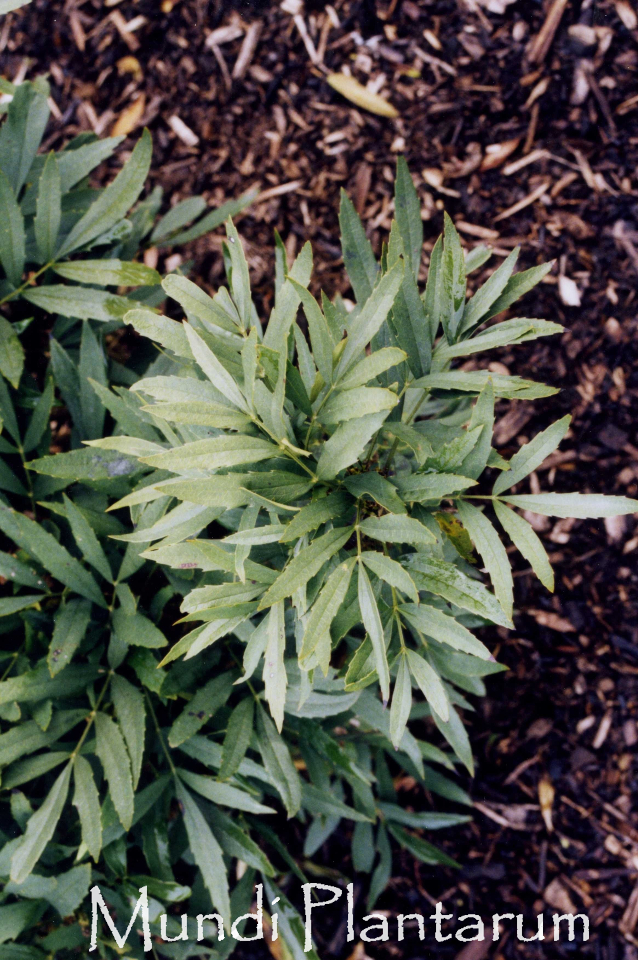
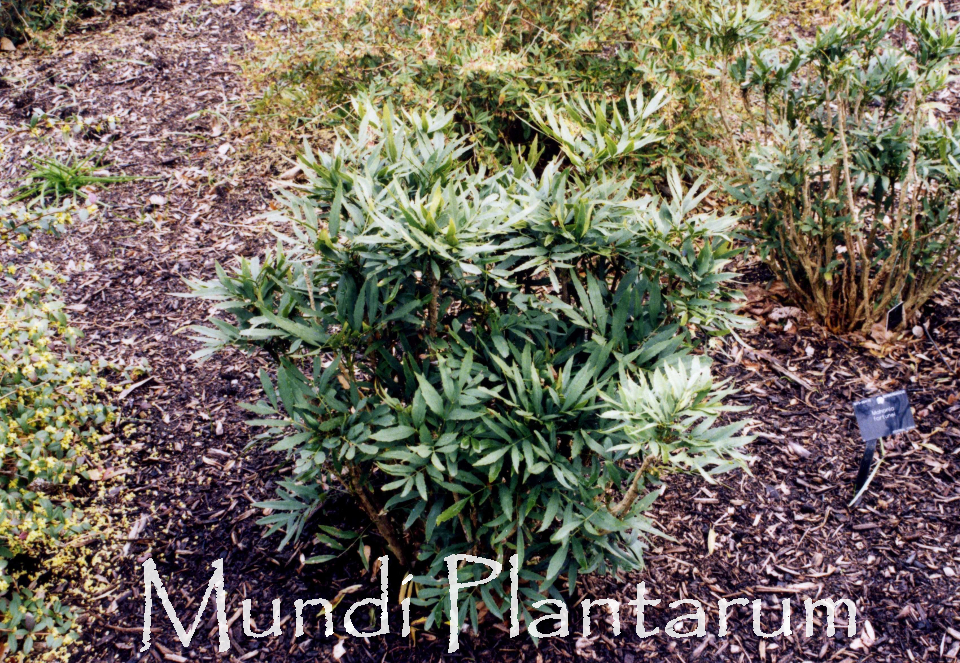
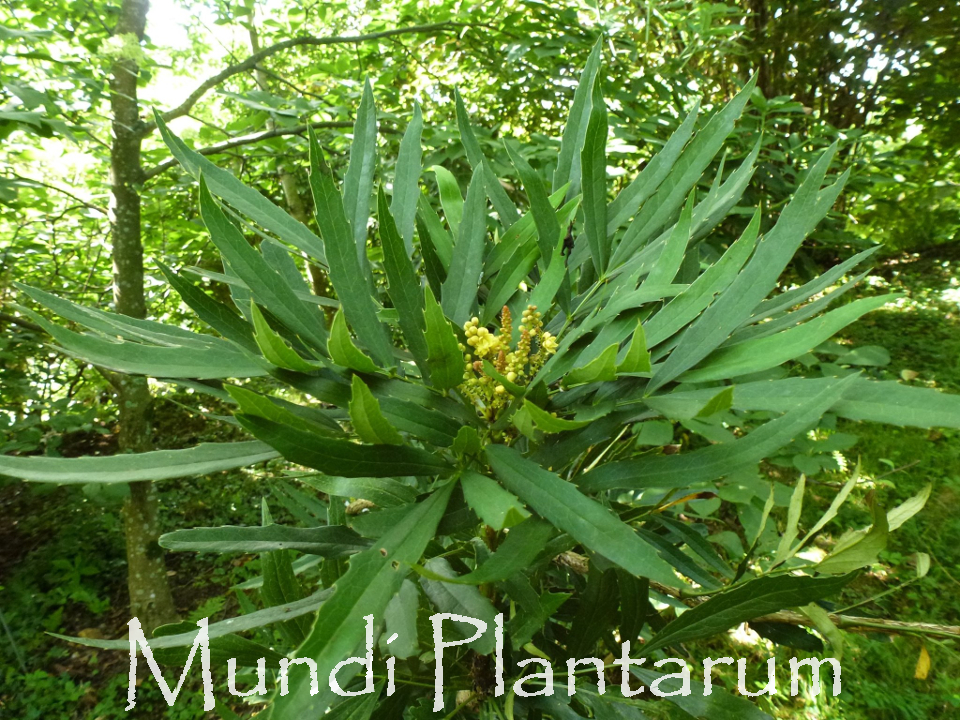
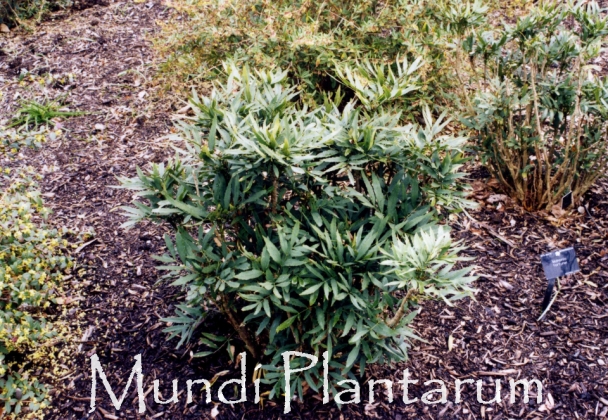
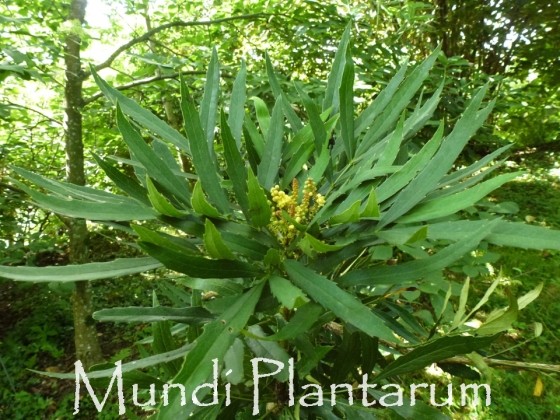
Long, narrow and slightly prickly leaves giving it a palm tree appearance.
Mahonia fortunei
Famille:
Berberidaceae
Synonymes:
Berberis fortunei
Les jardins du florilège
Les jardins du florilège
Paco Garin
Classification
Trees and shrubsClimate
Zone 8: from -12°C to -7°CLeaf color
- Green
Flower color
- Yellow
Sun exposure
- Sheltered winds
- Part shade
Size
100 to 150cm
Ornamental interest
- Foliage
- Evergreen
Garden use
- Parterre
GENERAL DESCRIPTION
- ORIGIN: 300-2000 m. China (Chongqing, Northeast Guangxi, Guizhou, Hubei, Hunan, Jiangxi, Sichuan, Taiwan, Zhejiang). Robert Fortune discovered this cultivated shrub in a Shanghai nursery and introduced it in 1846.
- CLIMATE: Withstands -10°C.
- EXPOSITION : Situation ombragée ou au soleil non brulant.
- SOIL: Humus-rich.
- GROWTH :
- PATHOLOGY:
- MULTIPLICATION:
- PRNING:
- USE: Ideal shrub for small gardens.
- MERITE:
GENERAL PHYSIOLOGY
- DIMENSIONS: Can reach 1.2m tall in cultivation, larger in nature.
- PORT: Upright.
- TRUNK:
- BARK:
- BRANCHES: Upright and unbranched stems.
- NOTE:
PHYSIOLOGY OF LEAVES
- SHAPE: Obovate to obovate-elliptic, 10-28 × 8-18 cm; usually composed of seven linear-lanceolate leaflets. Pinnate.
- COLOUR: Pale green leaves, sometimes slightly glaucous, pale green to dark green.
- NOTE: Leaves, evergreen.
PHYSIOLOGY OF FLOWERS
- TIME: Blooms in late autumn (October and November).
- FORM: Grouped in narrow cylindrical racemes 5 to 7.5 cm long, erect.
- COLOUR: Bright yellow.
- NOTE:
PHYSIOLOGY OF FRUIT
- SHAPE: Globular, 4-6 mm in diameter.
- COLOUR: Bluish-purple, pruinose.
- SEEDS :
- NOTE: This species rarely fruits in our latitudes.